The Murray River is Australia's longest river. It is an ecological stronghold in the south east of Australia. It drains westward from the Snowy Mountains and flows into the Southern Ocean at the Coorong in South Australia. Millions of people are reliant on the Murray River for the livelihoods and also for their drinking water. It is also of the utmost significance for a number of Aboriginal nations whose homelands are centred on and around the river.
The Murray Darling Basin drains over one million square kilometres of land, about 13% of the Australian continent. As a result of its size, the Murray will be a source of a multitude of contaminants washing in from a myriad of waterways which flow into it. Whilst the volume of water in the Murray will dilute many of these chemicals into smaller and smaller particles, there is still the risk that some contaminants will problematic even at miniscule levels.
Over the past few years the PFAS class of chemicals also known as forever chemicals have been in the media spotlight, with contamination issues found in many places around the country. These chemicals are problematic in parts per trillion. They also bioaccumulate in humans, animals and plants. FoE has attempted to document as many of these pollution events on the Australian PFAS Map.
PFAS monitoring in the Murray River has been limited to mainly what Victorian Water Authorities have been doing at offtakes to local water supplies. Most PFAS monitoring in the Murray River only started in 2024, although North East Water have been conducting PFAS monitoring since 2017. A couple of New South Wales Council's responsible for drinking water along the Murray also were involved in PFAS testing in the 2024 NSW Health PFAS Screening Program, with some positive results coming from Balranald Shire Council.
SA Water began testing at a couple of locations along the Murray River in May 2025 and April 2026. The SA Water samples were negative, but their level of detection was 20 times higher than similar monitoring conducted along the Murray by Lower Murray Water in Victoria. Crucially the SA Water limit of detection is 4 times higher than critical ecological guideline levels. It is highly likely that there is PFAS in the Murray River in South Australia but at levels lower than the level of detection used by SA Water.
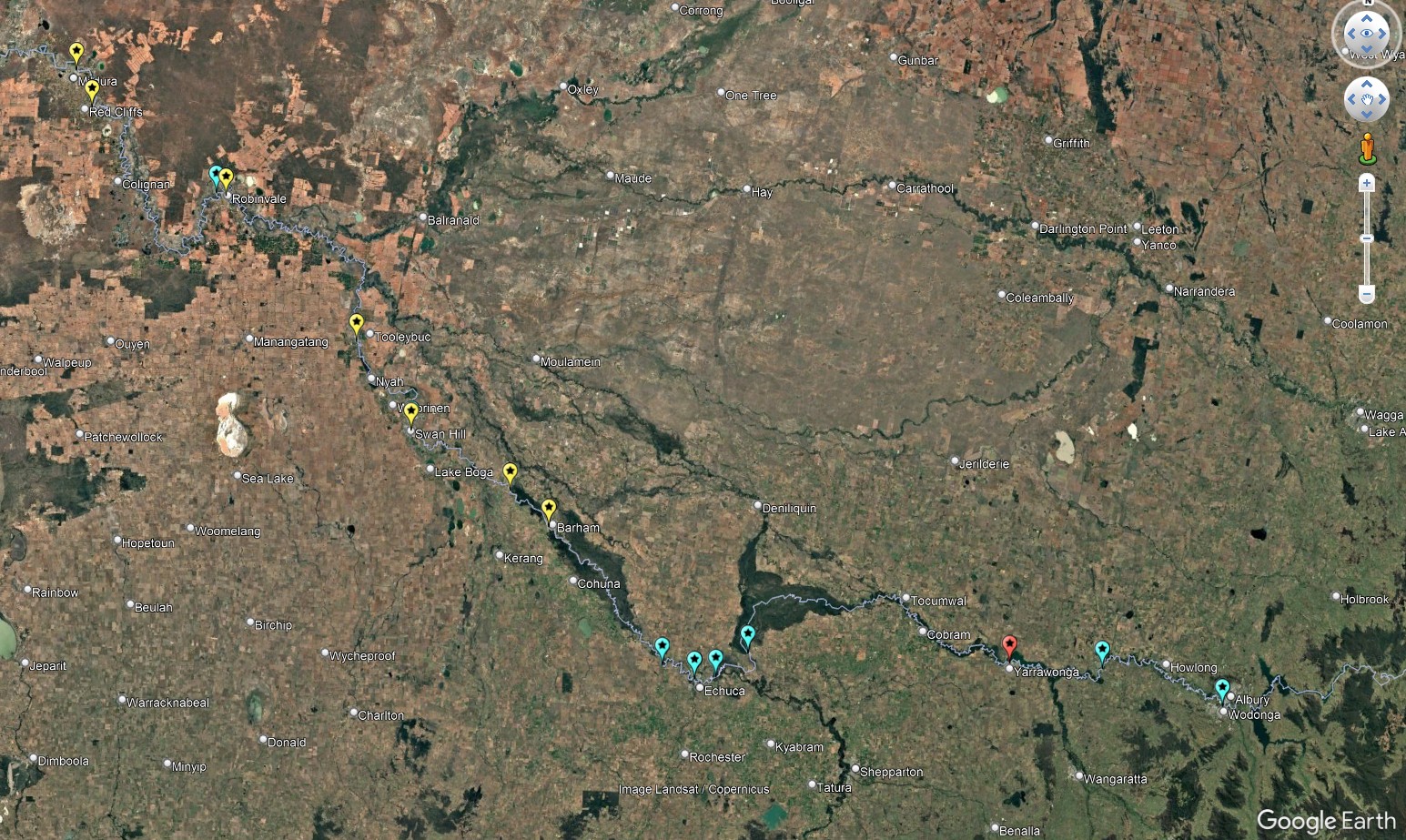
PFAS detections in the Murray River. The highest detection at Lake Mulwala is marked with a red pin. Yellow pins represent PFAS detections 2024-2026 by Lower Murray Water.
Health Guidelines
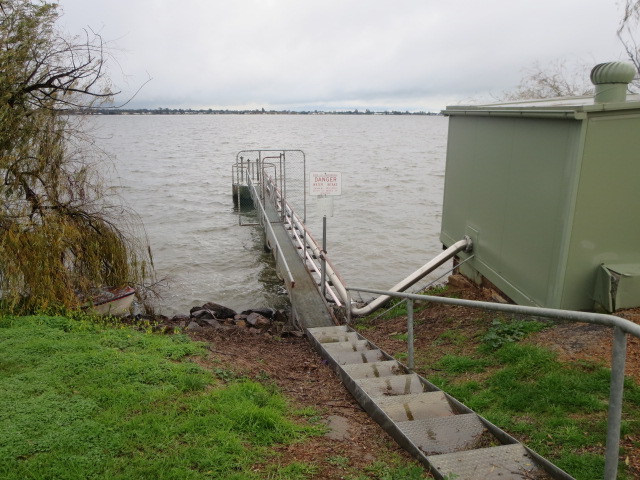
Lake Mulwala offtake, Yarrawonga's drinking water supply.
Almost all of information gained by Friends of the Earth has come via the Freedom of Information process. Lack of resourcing has meant that FoI's have only been sent to Victorian water authorities. Through this process FoE managed to find out that Victoria's highest PFAS pollution event in a drinking water supply, occurred at Lake Mulwala, Yarrawonga on July 13 2023. A total of 9 PFAS chemicals were detected at the same time, with the most significant being a PFOS detection of 0.29µg/L. At the time of the pollution event the Australian Drinking Water Guideline for PFOS (with PFHxS) was set at 0.07µg/L. This changed in June 2025 when the guideline level was reduced to 0.008µg/L. The PFOS detection at Mulwala therefore was 36 times higher than the 2025 Health Guideline. The water authority responsible for monitoring the drinking water at this location was North East Water. Another PFAS chemical, PFHxS was detected on the same day at 0.037µg/L (1.23 times) higher than the 2025 PFHxS guideline.
Between August 2017 and November 2024 North East Water detected PFAS chemicals 19 times in the Murray River with nine of these detections occurring at Lake Mulwala on July 13 2023.

PFAS chemicals have been detected at Lake Mulwala on 3 occasions. North East Water began PFAS testing in 2017. Despite the very high levels of PFAS detected in July 2023, average PFAS levels over the almost seven years of monitoring data, are well under drinking water guidelines, but above ecological guidelines.
The Lake Mulwala event was probably the result of an industrial release into the lake. As far as Friends of the Earth knows, the pollution event was never investigated, nor was the event reported by any media outlets. Lake Mulwala also recorded another PFAS pollution event on February 2 2018, when PFOS was detected at 0.015µg/L. Another PFAS chemical 6:2 FTS was detected at 0.036µg/L. No health guidelines exist for 6:2 FTS. On the same day PFOS and 6:2 FTS was detected at Wahgunyah, 35km upstream of Lake Mulwala. PFOS was detected at 0.013µg/L and 6:2 FTS at 0.031µg/L. Does this imply that over 30km's of the Murray River was polluted with PFAS in early February 2018?
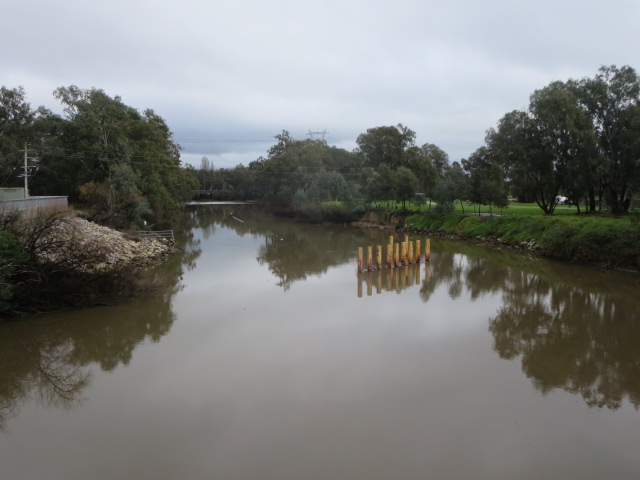
Wodonga water supply offtake is located on Wodonga Creek. Wodonga Creek could be described as being part of the Murray River floodplain between Albury and Wodonga.
PFAS detections in the Murray River between Wodonga and Lake Mulwala could be considered to be infrequent events. PFOS was first detected in Wodonga's raw water storage on 0.01µg/L on the 9th of November 2017. 6:2 FTS was then detected at Wodonga Pump Station on January 31 2018 at 0.012µg/L, with PFOS detected on February 7 2018 at 0.002µg/L, almost the same day as the detections at Waygunyah and Lake Mulwala. Does this imply that 100kms of the Murray River was impacted by PFAS on the same day in February 2018?
PFAS pollution has been a major concern at Bandiana Military Base for several years. Bandiana is located 4km south east of Wodonga. One the creeks flowing from Bandiana, Jack in the Box Creek flows into Wodonga Creek a couple of hundred metres from the Wodonga Water Treatment plant. PFOS was also detected at the Bandiana pump station on February 2 2018 at 0.003µg/L. Was the Military base the source of PFAS contamination in February 2018? High levels of PFAS were detected in Jack in the Box Creek in October 2017.
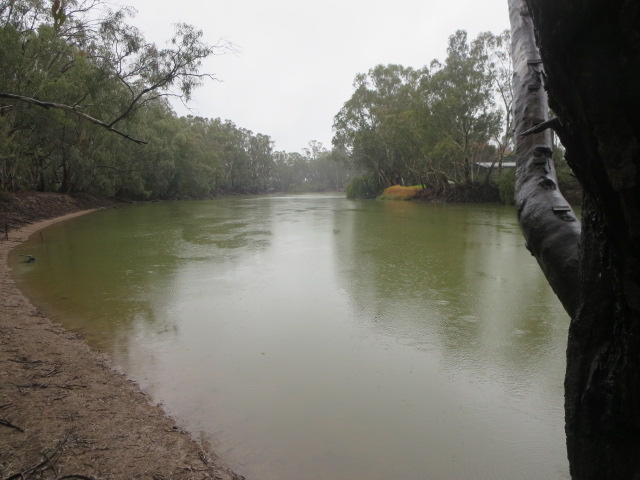
The Murray River at Koondrook
Lower Murray Water started testing for PFAS chemicals in drinking water supplies in December 2024. Between that date and February 2026 Lower Murray Water detected PFAS chemicals 26 times. PFAS chemicals have been detected at eight locations by Lower Murray Water. The reason they have had more detections than North East Water in a much shorter time period, could be that the laboratory employed by Lower Murray Water appears to be testing for PFAS chemicals at a Level of Detection 10 times lower than that employed by North East Water. This could also imply that testing by North East Water is not testing the full extent of lower level contamination.
Although the Lower Murray Water detections were under health guideline levels, they have more profound implications for the ecology of the river.
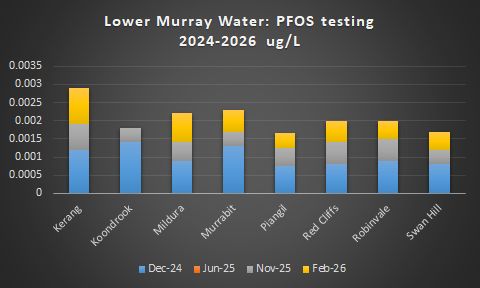
Of the 26 Lower Murray Water PFAS detections, 24 were for PFOS. The highest PFOS levels were recorded from Kerang which is supplied water from the Loddon River as well as from the Murray River Channel system. The seven other water supplies all pump drinking water from the Murray River. As PFOS was detected at all locations is the source water contaminated with PFOS along a 250km stretch of the Murray River that supplies Lower Murray Water?
| Town | PFOS µg/L average Dec 2024-Feb 2026 |
| Kerang | 0.0007 (also Loddon River) |
| Koondrook | 0.00045 |
| Mildura | 0.00056 |
| Murrabit | 0.0006 |
| Piangil | 0.00041 |
| Red Cliffs | 0.0005 |
| Robinvale | 0.0005 |
| Swan Hill | 0.00042 |
Average detections for PFOS in untreated water at these communities was between 5-9% of the Australian Drinking Water Guidelines, Ecological issues however are more profound.
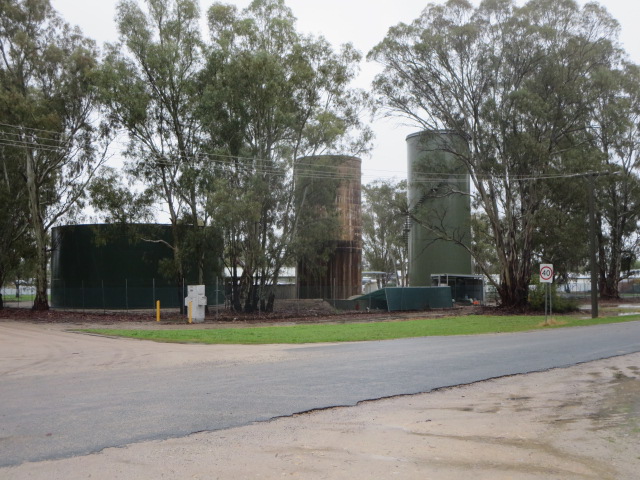
Koondrook water treatment plant.
Koondrook is located on the Victorian side of the Murray River. Barham is located on the NSW side. Lower Murray Water ran 4 PFAS test regimes between December 2024 and February 2026. It appears that Barham (Murray River Council) only ran one set of tests in December 2024 reporting that "water is fully compliant and safe".
Further down the Murray River, Robinvale is on the Victorian side of the river, with Euston (Balranald Shire Council) being on the NSW site. Robinvale detected PFOS three times between December 2024 and February 2026. Euston detected three PFAS chemicals in December 2024, PFOA 0.0005µg/L, PFHxS 0.0008µg/L and PFOA 0.0008µg/L.
Goulburn Valley Water detected the PFAS chemical PFOA at 0.0034µg/L at Barmah on February 2 2024. PFOA has a drinking water guideline of 0.2µg/L, meaning that the PFOA detection was 1.7% of the drinking water guideline.
Ecological Guidelines
Water authorities have one primary interest only and that is to safeguard the drinking water supply in terms of potential health impacts to their customers. The ecological impact of the pesticides that are detected are usually ignored in water authority reporting. Nevertheless, water authority data is useful in also looking at potential ecological impacts.
ANZECC ecological default guideline values (DGV'S) are divided into categories that offer different guideline levels in relation to the quality of the waterway. For instance, a degraded waterway in an urban environment will grant an ecological guideline of 80% meaning that due to existing degradation there has already been species loss. A guideline of 80% will therefore warrant ‘protection’ for 80% of species in that waterway. The highest level of protection is 99% for waterways in high quality environments. 95% protection is generally granted to agricultural areas where some species loss has already occurred. It is assumed that the Murray River would be classified as being a slightly to moderately disturbed ecosystem. The lower the ANZECC guideline, the higher amount of toxicants are 'allowed'.
In March 2026 the previous Draft PFOS 99% Default Guideline Value (DGV) was approved as 'official' and increased almost 87 times from 0.00023µg/L to 0.02µg/L. There was no media reporting this increase in the DGV. Ecological guidelines only apply to PFOS and not the myriad of other PFAS chemicals that could be in the environment.
The March 2026 ANZECC Guidelines however allow for a PFOS Biota Screening Threshold of 0.0005µg/L which incorporates potential ecological impacts of bioaccumulation in aquatic food chains.
"Although the 99% species protection DGV is recommended to protect species from bioaccumulation of PFOS, biota in the water may have tissue concentrations of PFOS that exceed the PFAS NEMP 3.0 biota guideline values regardless of whether the water quality meets the DGV potentially leading to biomagnification concerns. The 99% DGV alone may not be sufficient to protect organisms that consume these biota (e.g. predators such as birds). To address the risk to higher consumers, a biota screening threshold for PFOS in freshwater of 0.0005 μg/L is recommended – exceedance of this concentration may result in PFOS concentrations in aquatic biota that exceed the PFAS NEMP 3.0 biota guideline values. Exceedance of the biota screening threshold should trigger an assessment of PFOS concentrations in aquatic biota tissues to assess the possible risk to mammalian and avian predators." Toxicant default guideline values for aquatic ecosystem protection Perfluorooctane sulfonate (PFOS) in freshwater Technical brief March 2026
Therefore if looking at potential bioaccumulative and ecological impacts of PFOS, the 0.0005µg/L level should be used for the Murray River.
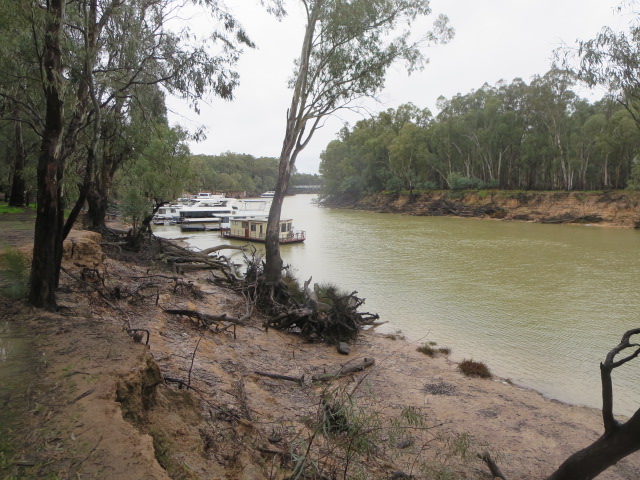
The Murray River at Echuca.
EPA Victoria ran a sampling program for contaminants in floodwater in late 2022. In terms of the Murray River at Echuca, the EPA detected PFOS, PFHxS and PFBS. PFOS was detected once on 31/10/22 at 0.0006µg/L. PFOS was also detected in the Campaspe River at Echuca on 8/11/22 at 0.001µg/L. PFOS was also detected at the Goulburn River Echuca on 31/10/22 at 0.001µg/L.
Prior to this monitoring, the EPA in 2019 also detected PFOS at 0.001µg/L at Richardsons Lagoon Echuca. PFOS was also detected in breast meat of water fowl including Grey Teal and Pacific Black Duck at levels above trigger levels.
EPA flood water monitoring in 2022 in the Little Murray River near Swan Hill detected 4 PFAS chemicals with levels of PFOS as high as 0.0007µg/L
The EPA also detected the PFAS pesticides Flutriafol in the Campaspe River and Goulburn River near Echuca and the PFAS pesticide Epoxiconazole upstream of the Echuca water supply in October 2022.
All 10 detections of PFOS in or near the Murray River in 2022 by the EPA Victoria exceeded 0.0005µg/L.
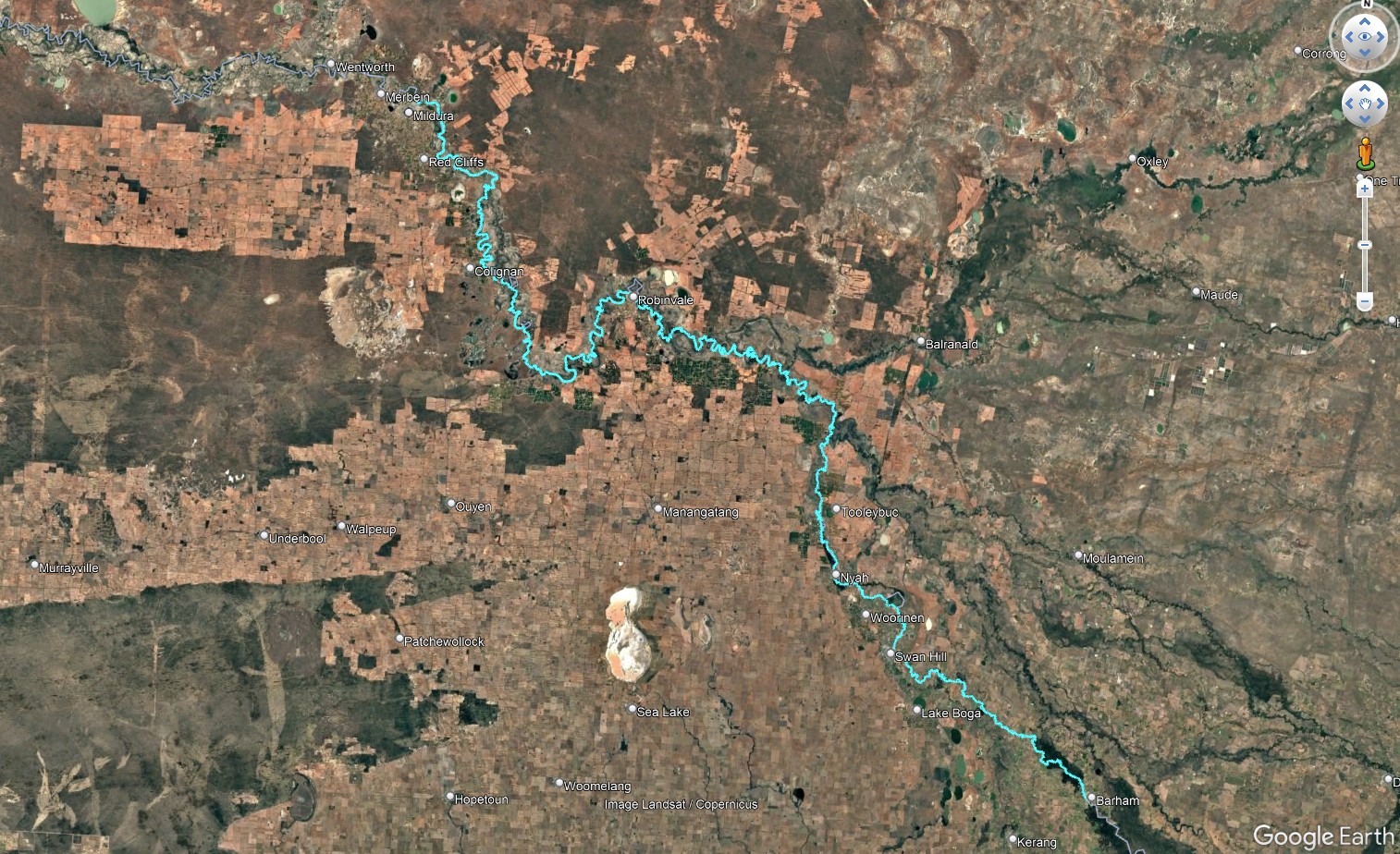
PFOS could be present at ecologically dangerous levels over possibly hundreds of km's of the Murray River. Lower Murray Water tests at 8 locations between December 2024 and February 2026 confirmed the presence of PFAS.
Perhaps most interestingly are the PFAS detections by Lower Murray Water between December 2024 and February 2026. Of the 24 positive PFOS detections, 19 (79%) were equal to or greater than the 99% PFOS BST. (32 actual PFOS tests were conducted by Lower Murray Water, all were negative in June 2025, meaning 59% of detections between December 2024 and February 2026 were equal to or greater than 0.0005µg/L). Even PFOS average levels at Kerang, Mildura, Murrabit, Red Cliffs and Robinvale were equal to or exceeded the 99% BST. This could imply that a large stretch of the Murray River from Koondrook to Mildura could be impacted by PFOS levels which could have bioaccumulative impacts to hundreds of species reliant on the Murray River.
The North East Water detections recorded between 2017 and 2024 are more sporadic and perhaps reflect less chronic PFAS pollution in the stretch of the Murray River between Wodonga and Yarrawonga. The table below highlights the number of detections and the average PFOS detection level. Only Lake Mulwala exceeds the PFOS Biota Screening Threshold. Indeed Lake Mulwala maintains the highest average PFOS levels anywhere along the Murray River despite only recording two PFOS detections between February 2018 and October 2024.
| Location | Dates | PFOS detections | Average PFOS level µg/L |
| Wodonga Raw Water Storage | August 2017 - October 2021 | 1 | 0.000333 |
| Wodonga Pump Station | November 2017 - October 2024 | 1 | 0.000026 |
| Bandiana Pump Station | November 2017 - May 2018 | 1 | 0.00012 |
| Wahgunyah | February 2018 - November 2024 | 1 | 0.000178 |
| Lake Mulwala | February 2018 - October 2024 | 2 | 0.004122 |
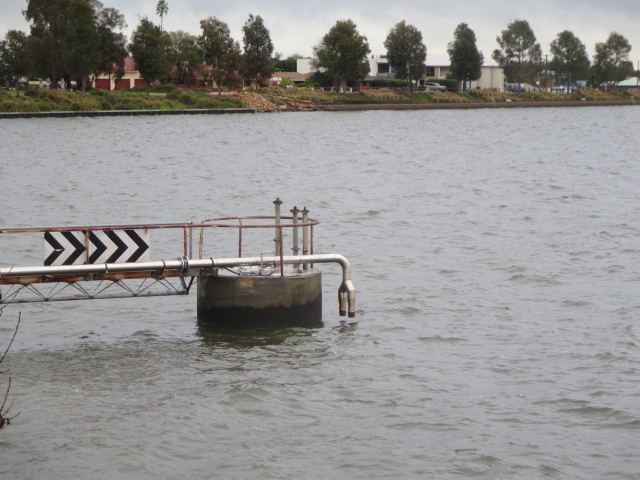
Lake Mulwala offtake at Yarrawonga. Just what was the source of the PFAS pollution events recorded here in February 2018 and July 2023? Why wasn't the pollution investigated?
Donations for this work are always greatly appreciated. You can do so here.
For more information contact [email protected]