In late 2024 Friends of the Earth Australia submitted information to the NSW Legislative Council Select Committee on PFAS contamination, chaired by Greens MLC Cate Faehrmann. In February FoE Campaigner Anthony Amis was invited to speak by the Committee at a Public Hearing in Sydney. The final report was tabled in the Legislative Council on the 11th of September. A number of issues raised by Friends of the Earth were published in the report.
Did you know FoE's Australian PFAS map has had over 17,000 active users over the past year?
Any help with helping with our toxics campaign work can be made here
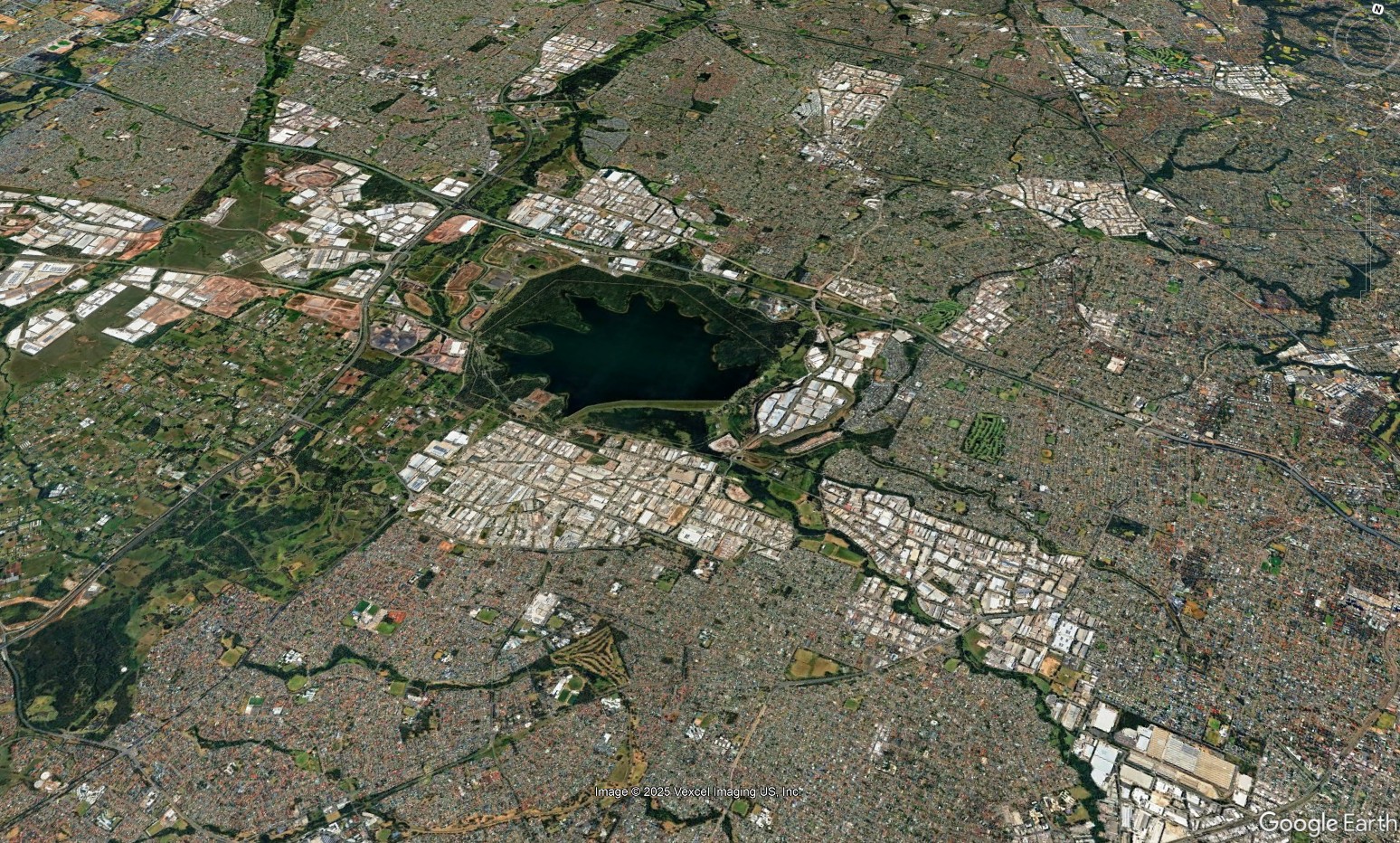
Prospect Reservoir in Sydney. Water in Prospect is supplied mainly from Warragamba Dam and Upper Nepean Dams. Why has noone in the NSW Government or media publicly raised the issue of PFAS chemicals including Perfluorobutanoic acid (PFBA) contamination at Prospect? Prospect Water Filtration Plant supplies 4.2 million people in Sydney with drinking water and 85% of Greater Sydney. (15.4% of Australia's population rely on Prospect Water Filtration Plant for drinking water).
Key findings of the Select Committee which Friends of the Earth highlighted in our submission and consultation included:
Finding 11: The revised Australian Drinking Water Guidelines continue to permit higher levels of key PFAS chemicals—PFOS, PFHxS and PFOA—than comparable international standards, despite evidence of their adverse health effects, particularly for PFOA, which is 50 times higher than the US standard, despite PFOA being classified as carcinogenic to humans.
Finding 12: There is no requirement for water utilities to report testing data for PFAS chemicals not currently covered by Australian Drinking Water Guideline limits, despite evidence that spikes in these
chemicals can and do occur. This limits the ability of public health agencies to evaluate whether additional PFAS chemicals should be subject to regulatory standards.
Finding 13: Preventing PFAS chemicals from entering the environment in the first place is essential to averting harm and, as far as possible, avoiding the need for expensive remediation and treatment of PFAS in New South Wales.
Finding 15: There is a lack of transparency and adequate regulation around the historical application of biosolids in New South Wales. This includes insufficient monitoring of downstream impacts on soil and water quality, despite evidence linking biosolid use to PFAS contamination in waterways such as the Belubula River.
Finding 16: The revised standards under the PFAS National Environmental Management Plan Version 3.0 could render a significant proportion of biosolids produced by New South Wales water utilities unsuitable for agricultural reuse. This highlights the urgent need for phasing out PFAS chemicals, investment in treatment technologies and improved monitoring and compliance systems.
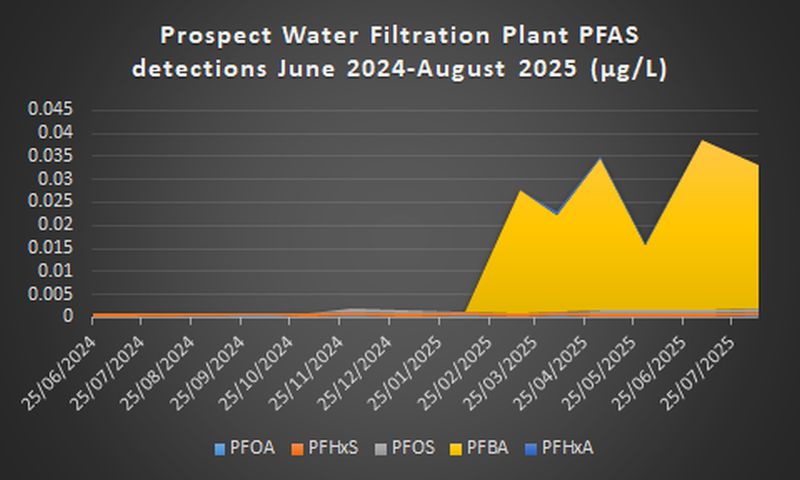
Sydney Water PFAS detections in raw water at Prospect Water Filtration Plant June 2024-August 2025. Detections are dominated by Perfluorobutanoic acid (PFBA). There is no Australian drinking water guideline for PFBA! Several water filtration plants around the Sydney area have seen PFBA dominate PFAS detections over the past year, including Macarthur, Nepean, Warragamba, Illawarra, Woronora, Orchard Hills, North Richmond and Cascade. FoE first raised concerns about PFBA detections in Sydney drinking water supply's in February 2025.
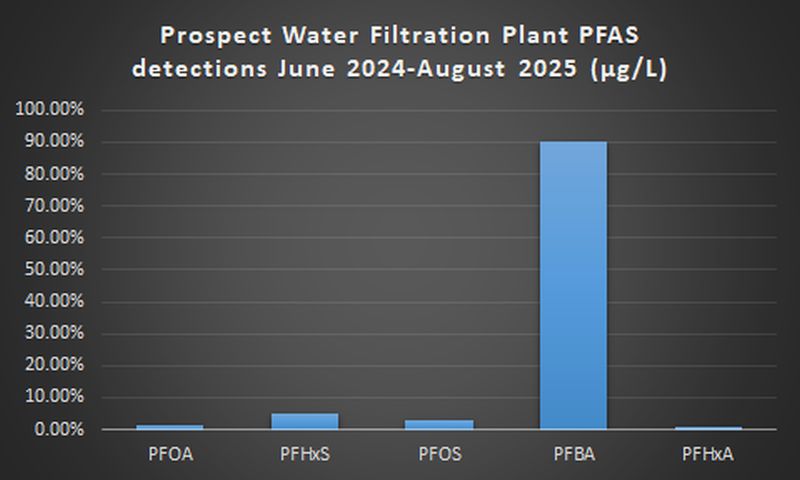
Sydney Water PFAS detections Prospect Water Filtration Plant June 2024-August 2025. PFBA dominates test results, with PFBA detections since March 2025 accounting for 90% of all PFAS detections at Prospect over 14 month period. Water NSW and Sydney Water testing at Prospect Water Filtration plant also shows PFOS averaging 9.45% of the newly revised Australian drinking water guidelines.
FoE's submission also helped the committee make the following recommendations:
Recommendation 1: That the NSW Government ensure regular PFAS testing of water across New South Wales and that this require:
• risk-based testing of source water, water at treatment plants before and after treatment, and water in the distribution system
• testing to a set of pre-determined standards, consistent with current best practice with requirements for periodic review, and
• timely, accessible public disclosure of the results.
Recommendation 2: That in publishing data concerning PFAS, government agencies do so in a format that:
• is easily searchable and accessible, and
• makes extracting and understanding the data as easy as possible in order to aid research and better inform the public around PFAS.
Recommendation 8: That the NSW Government undertake an audit of the state’s ‘high conservation value’ and ‘slightly to moderately disturbed’ freshwater ecosystems to determine which do not meet the 99 per cent
ecological water quality guideline for PFAS, and take action to identify source pollution and prevent and remediate contamination wherever possible.
Recommendation 9: That, in investigating the cause of elevated PFAS levels within waterways, it be standard procedure for government investigators to consult with Fire and Rescue NSW about whether historically
there have been any significant traffic accidents on nearby roadways at which large amounts of PFAS-containing foam has been used and, if so, there be follow-on investigations as to where that foam flowed.
Recommendation 24: That the NSW Government call on the Australian Government to regularly review the available evidence on PFAS and incorporate other relevant chemicals in the Australian Drinking Water
Guidelines when appropriate.
Recommendation 28: That the NSW Government work via National Cabinet on a plan to phase out all non-essential uses of PFAS in consumer, commercial, and industrial products by 2030, in line with emerging
international best practice, and work with other jurisdictions to establish clear criteria for defining essential uses.
Recommendation 29: That the NSW Government urgently undertake a comprehensive, state-wide audit of past and current sites where biosolids have been applied, including agricultural land, forests, mine
remediation sites and composting facilities, to identify and monitor potential PFAS contamination.
Recommendation 30: That the NSW Government expand the PFAS Investigation Program to specifically include biosolids as a focus area, and ensure monitoring occurs downstream from biosolid application sites,
including testing of soil, groundwater, and adjacent waterways.
Some quotes attributed to FoE include:
p5 Finally, Mr Anthony Amis of Friends of the Earth Australia raised concerns that PFAS could even be in the rain and that he has observed a connection between PFBA spikes in reservoirs around Sydney and rainfall events (PFBA – or perfluorobutanoic acid – is a member of the PFAS family of chemicals). Mr Amis expressed disquiet about the possible widespread impacts if this is the case:
It seems to be happening when there are high rainfall events. I'm worried that there could be PFAS coming down in the rain ending up in reservoirs, waterways. It seems to be at higher levels around the urban environments, which makes sense because that's where the majority of the PFAS is being used. But if we've got it coming down in rainfall, well, you can imagine the ecological impact of that across wide areas of New South Wales, particularly that urban area around Sydney. We've got PFBA happening in these reservoirs which have got largely closed catchments upstream, so how the hell is this stuff getting into the reservoirs?
p71 Amidst these calls for greater accountability for water authorities, some stakeholders also argued that water quality provisions needed to be strengthened to improve compliance. For example, Mr Amis of Friends of the Earth Australia argued that penalties should be imposed on authorities where they do not meet the drinking water guidelines: …I think that there needs to be some sort of legal enforcement of drinking water guidelines so that—there's got to be some legal recourse. Water authorities, if they end up providing dangerous drinking water to communities, there needs to be some sort of legal stick that can be used to make sure that they don't do that again and that other
authorities—because, at the moment, the drinking water authority's guidelines are guidelines only. There's no real legal teeth.
p 160 For example, Mr Anthony Amis, Land Use Researcher, Friends of the Earth Australia stated on 5 February 2025 that while it was his understanding Sydney Water was testing for 30 PFAS chemicals, it was only publishing results for the three for which there were drinking water guidelines at the time: PFOS, PFHxS and PFOA. Mr Amis commented: I think you need to capture the whole host of PFAS chemicals, or at least the 30 that Sydney Water are testing for. Part of the problem with the NHMRC…we might end up with drinking water guidelines for only four or five, but there could be literally up to 50 that have been detected across Australia. So we could be in a scenario in 10 years' time
where, yes, we've got drinking water guidelines for the three, four or five chemicals, but it's still going to be missing the majority of PFAS, which might be in the environment and might actually be in tap water.
p 161 Mr Amis noted in particular that Sydney Water does not report on the PFAS chemical PFBA, and the ADWG do not include a guideline limit in respect of it. He indicated he does not understand this after documents he received in early 2025, pursuant to applications under the Government Information (Public Access) Act 2009, revealed spikes of this chemical in various water supplies in New South Wales: What has been interesting with those GIPAA requests is there seems to be spikes in a number of New South Wales water supplies, particularly in Sydney, with the PFAS chemical PFBA. I was first alerted to this—it happened in the Blue Mountains in December. We got a spike of PFBA up there following some rainfall events that happened in the Blue Mountains in December. The GIPAA request from Sydney Water also reveals high levels of PFBA at Macarthur Water Filtration Plant, Illawarra Water Filtration Plant, Woronora Water Filtration Plant and Nepean Water Filtration Plant. Mr Amis also stated that PFBA 'seems to be the highest frequently detected PFAS chemical, at least in New South Wales'. In addition, in response to questioning he confirmed he had not seen any testing in Australia for the 'Gen X' PFAS chemicals for which there are drinking water standards in the USA, and he said the other PFAS chemical causing him worry was one called TFA – trifluoroacetic acid which he understands Australian laboratories are unable to test for.
p 168/169 Mr Amis of Friends of the Earth Australia noted the wide range of products PFAS chemicals are found in, causing an unsustainable level of contamination for the water industry to remediate. In these circumstances, he called for a staged ban on products containing PFAS as the only solution: I think it needs to be banned… It's not a sustainable outcome that the water industry has to deal with this problem, which they haven't created… It won't happen overnight, that's for sure. This stuff is entwined in the very fabric of our society… I think what you really need to do is look strategically at what are the biggest uses of PFAS chemicals. We need to maybe start looking at it industry by industry, but also looking at easier options like if it's found in cosmetics or items that can be easily banned. I think there should be a ban enacted, but what we really need to get at is the breadth of where the PFAS chemicals are and then look strategically at what are the easiest ways to stop this stuff from entering, at least, wastewater streams?
p177/178 Mr Amis of Friends of the Earth Australia has undertaken extensive research on the spread of PFAS through the application of biosolids on agricultural land in particular. He noted the PFAS National Environment Plan (NEMP) Version 3.0, which has now come into force and introduces new and additional guidance and standards on priority areas including risk-based criteria for re-use of biosolids contaminated with PFAS. Mr Amis questioned whether authorities would be able to meet revised guideline values for biosolids imposed under this new version of the NEMP:
In terms of Sydney Water biosolids, I did a GIPAA request back in June last year. What I found in that was about a quarter of all the biosolids produced by Sydney Water are above the restricted guideline level that has been proposed by NEMP. My question was what happens to that 25 per cent of Sydney Water biosolids that exceed the guideline levels.
In addition, Mr Amis expressed disquiet about the application of biosolids in the past, urging the government to do an audit to see if there has been resulting PFAS contamination, and he provided examples of possible areas of concern:
I've heard anecdotally that there have been biosolids from Sydney Water applied on pine plantations. Well, which ones and where are they located? Are they located in water supply catchments? Mine remediation. What mines around the State have had these biosolids applied to them? I want the Committee to know that these biosolids are problems for 50, 60 years.
…I've also got an issue with farms where these biosolids are being applied. I don’t think there's any monitoring going on downstream or even monitoring of the soil for PFAS…I think it's quite a serious issue that no-one has been paying much attention to. Are PFAS from biosolids ending up in waterways? I think the issue at Blayney is a really interesting one. There's a big composting facility west of Blayney. Highest levels of PFOS in the Belubula River seem to be coming from the creek, which is very close to a biosolids facility.
Indeed, as discussed in chapter four, recent investigations by the EPA have found that the Blayney composting facility, Australian Native Landscapes compost site, is the most likely source of PFAS contamination that has affected the Belubula River. A December 2024 round of sampling revealed the highest levels of PFAS were within Cowriga Creek, downstream of the compost site, and within Mackenzies Waterhole Creek, near the landfill. Both of these creeks
are tributaries of the Belubula River.761 Amongst other things, this facility manages biosolids.
p 180 Finally, the committee found persuasive Mr Amis' argument that there should be an audit of areas where biosolids were applied in the past to check for PFAS contamination, particularly given evidence potentially linking recently discovered contamination in the Belubula River in central west New South Wales partly to a compost facility at Blayney that handles biosolids. Indeed, biosolids should be an active consideration in the PFAS investigation program, the
government's program to investigate legacy PFAS contamination in New South Wales, led by the EPA and discussed throughout the report.
It was disappointing that the Committee failed to look into issues surrounding Bathurst's drinking water supply, issues that were raised by Friends of the Earth in its submission. FoE has been pointing the finger at possible use of biosolids or recycled water in the Macquarie River at Bathurst for some time.
Recent developments
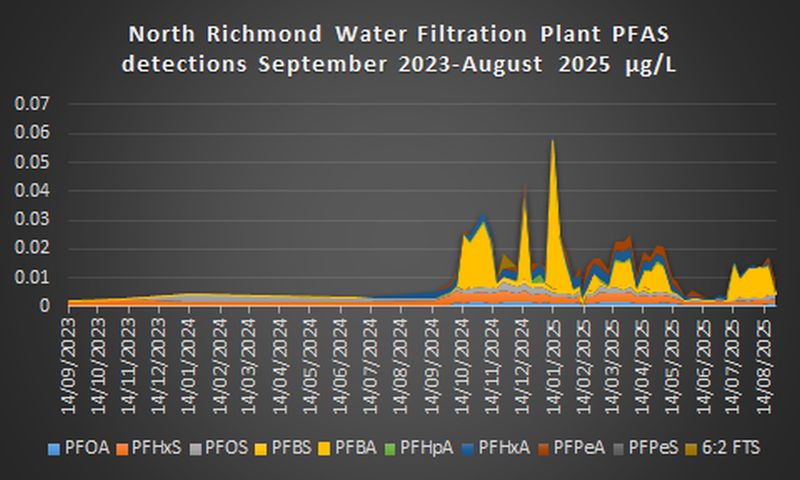
Sydney Water PFAS detections at North Richmond WFS. Note PFBA spikes which account for 39% of all detections at North Richmond..
A recent study by the University of New South Wales has found at least 31 PFAS chemicals, including 21 not previously recorded in Australian tap water, and one detected in tap water globally for the first time (3:3 FTCA). Almost all monitoring of drinking water supplies occurs in raw water - pre treatment. The standard way of thinking is that if levels of chemicals occur above drinking water guidelines in raw water are higher than drinking water guidelines, then this will warrant further testing of tap water. But no testing of tap water will occur if the levels in raw water are less than drinking water guidelines as it is assumed that treatment at water treatment plants will remove (or greatly diminish) the substance of concern. The recent study by University of NSW indicates that PFAS chemicals could be increasing through the distribution network and transforming into PFAS chemicals that are not picked up by raw water monitoring. It could also mean that PFAS chemicals are being released within the reticulation network itself. This is highlighted by detections of PFAS chemicals in the North Richmond area in the UNSW study at levels much higher than Sydney Water detections at the North Richmond WFP. The UNSW samples were taken in February 2024 and reveal PFOS at an average almost 3 times higher than detected by Sydney Water between September 2023 and 2025. They also reveal some PFAS chemicals that have not been detected by Sydney Water. Sydney Water are now publishing details of all 30 PFAS chemicals that they are testing for across the Sydney region, following a Friends of the Earth GIPA request requesting this information. Sydney Water also also publishing on a weekly basis PFAS detections at Cascade WFP in the Blue Mountains and North Richmond WFP. Other Sydney Water WFP's information is published on a monthly basis. Water NSW has also been publishing monthly results for PFAS chemicals for some Sydney reservoirs that they have responsibility for.
In FoE's submission to the NSW Select Committee FoE raised concerns about lack of testing for TFA (Trifluoroacetic Acid) "the other PFAS chemical causing him worry was one called TFA – trifluoroacetic acid which he understands Australian laboratories are unable to test for". In an Australian first, urine samples have recently been tested for TFA and show high chronic exposure to TFA in Australia, consistent with ubiquitous TFA in food, household dust, and drinking water reported in other countries. TFA is a degradation product of numerous industrial chemicals, pharmaceuticals, and pesticides and has recently been found to be widespread in many European water catchments and drinking water supplies. No environmental testing has occurred in Australia for TFA. TFA is a synthetic organofluorine compound, a subclass of short chain PFAS chemicals.
For more information contact: [email protected]
Any help with helping with our toxics campaign work can be made here