Recent media reported by the ABC has highlighted concerns regarding PFAS contamination of Wagga Wagga's drinking water supply. Friends of the Earth has been concerned about the situation at Wagga Wagga for some years particularly when water quality monitoring by Riverina Water in 2024 started showing PFAS detections in groundwater bores supplying West Wagga.
Almost all attention at Wagga Wagga in regards to PFAS has related to contamination of groundwater from defence bases. The Military bases, particularly the RAAF Base located 10 km east of Wagga Wagga's CBD has created polluted groundwater plumes that not only have impacted the nearby Gumly Gumly Wetland and fish farm located in the wetland, but have been slowly moving westwards towards the East Wagga groundwater bores that supply the town. All contamination risks publicised by the media have focused on the Eastern Bores. Now attention has rightfully been applied to the Western Bores, which have not been polluted by the Department of Defence, but other sources.
Friends of the Earth believes that one possible source of contamination of the Western Bores could be a sewage treatment plant at Narrung Street located less than 2km north the CBD. The sewage treatment plant is run by the Wagga Wagga City Council. Friends of the Earth applied to the Council under GIPA legislation, in February 2026 for information pertaining to PFAS detections by Wagga Council of their 3 sewage plants. We received the information a month later in March 2026 and have been waiting to publicise the information.
Friends of the Earth also urges Wagga Wagga City Council and the NSW EPA to urgently undertake hydrological work to determine the extent and sources of PFAS pollution of the West Wagga Bores.

Map of Wagga highlighting key PFAS hotpots. The RAAF base on the right of the image has been the site of widespread PFAS contamination. PFAS from the site has impacted the Gumly Gumly wetland and groundwater almost as far west as Wagga Water Treatment Plant (marked Wagga WTP on the map). Kapooka Army Base (Blamey Barracks) located west of the town is another source of PFAS, with PFAS draining the site in a northerly direction. West Wagga water treatment plant is marked with the blue pin. The location of the three sewage treatment plants at Wagga are marked with the red pins. They are Forest Hill STP, Kooringal STP and Narrung STP. Main drainage lines/creeks have been highlighted in blue and yellow.
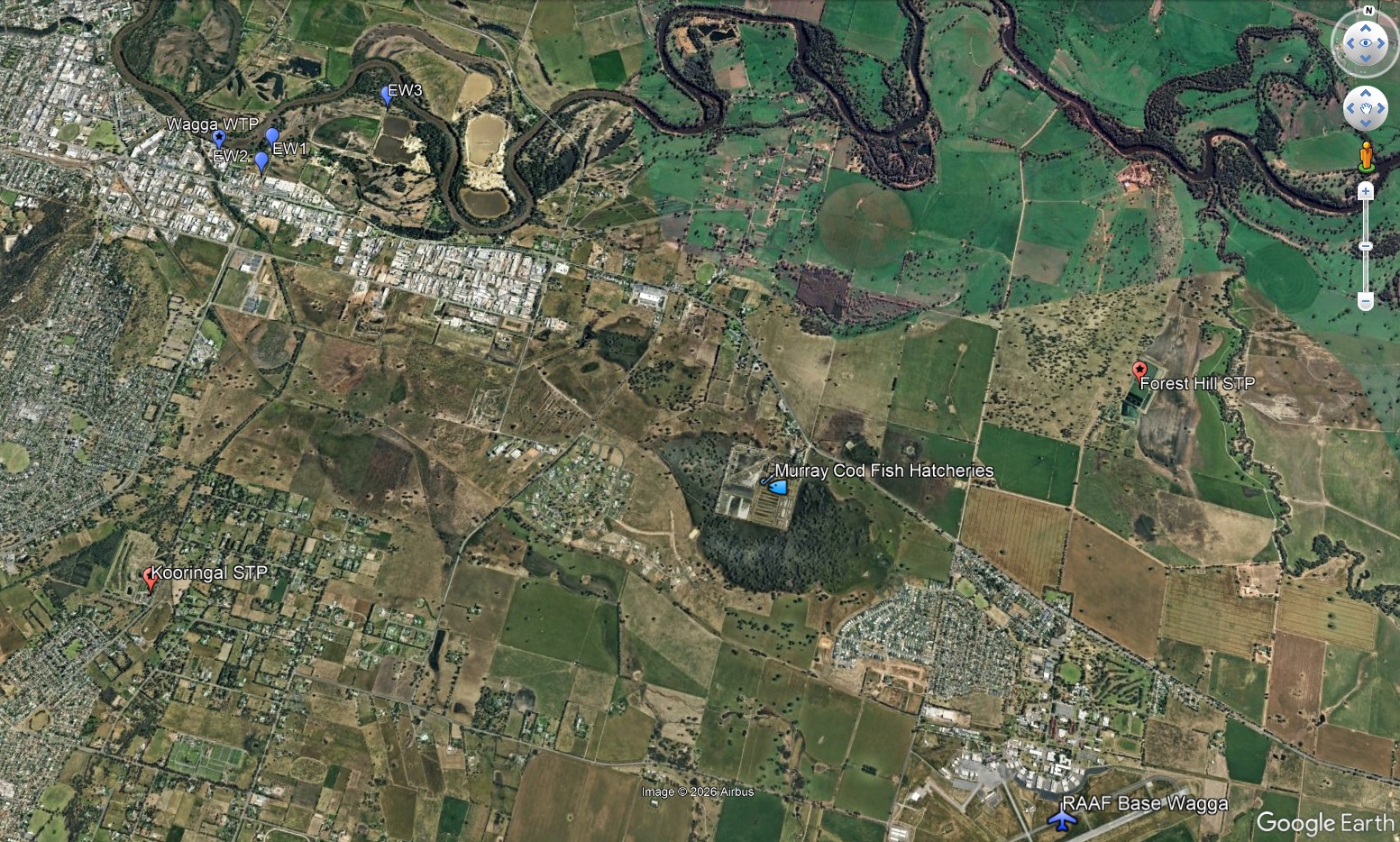
The Eastern Wagga water supply system highlighting the location of the Wagga Water Treatment Plant and three drinking water bores, EW1, EW2 and EW3. The water treatment plant also pumps water from the Murrumbidgee River, meaning that the bore water is 'diluted' with river water. Murray Cod Fish Hatcheries was forced to close down in 2018 due to PFAS pollution.
The predominant source of drinking water for Wagga Wagga is the Murrumbidgee Alluvial Groundwater Source which has a groundwater entitlement of 14GL per year. 7GL is also supplied from the Murrumbidgee River. About 18% of total drinking water for Wagga Wagga has been impacted by PFAS. Riverina Water has detected PFAS in water from the Murrumbidgee on seven occasions between February 2025 and February 2026, with PFOS averaging 4.6% of the Australian Drinking Water Guidelines during that time.
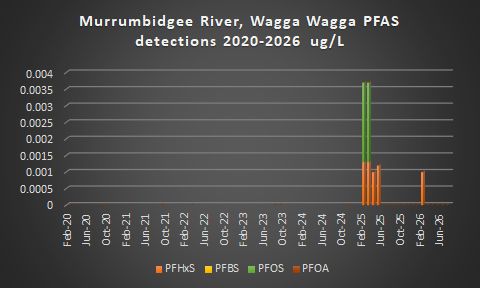
PFAS chemicals have also been detected in the Murrumbidgee River at the offtake to the Murrumbidgee Water Treatment Plant. If appropriate treatment is used, such as Reverse Osmosis or Powder Activated Carbon, PFAS levels will be greatly minimised. The Murrumbidgee River supplies about one third of Wagga Wagga's drinking water. The two PFOS detections in February and March 2025 exceed the new ecological 99% biota screening threshold of 0.0005µg/L by almost 5 times, implying that the ecology of the Murrumbidgee River may also be suffering from PFOS 'stress'.
Polluted PFAS plumes from the RAAF base started impacting EW1 in November 2024, EW 2 in November 2024 and EW3 in February 2025. Average PFAS detections at EW 1 (December 2024/July 2026) have been PFOS 0.000457µg/L and PFHxS 0.0007µg/L. (5.7% and 2.3% of the Australian Drinking Water Guidelines respectively). Average PFAS detections at EW 2 (December 2024/July 2026) have been PFOS 0.00066µg/L and PFHxS 0.0039µg/L. (8.3% and 14% of the Australian Drinking Water Guidelines respectively). Average PFAS detections at EW3 (February 2025/February 2026) have been PFOS 0.0007µg/L and PFHxS 0.0004µg/L respectively.
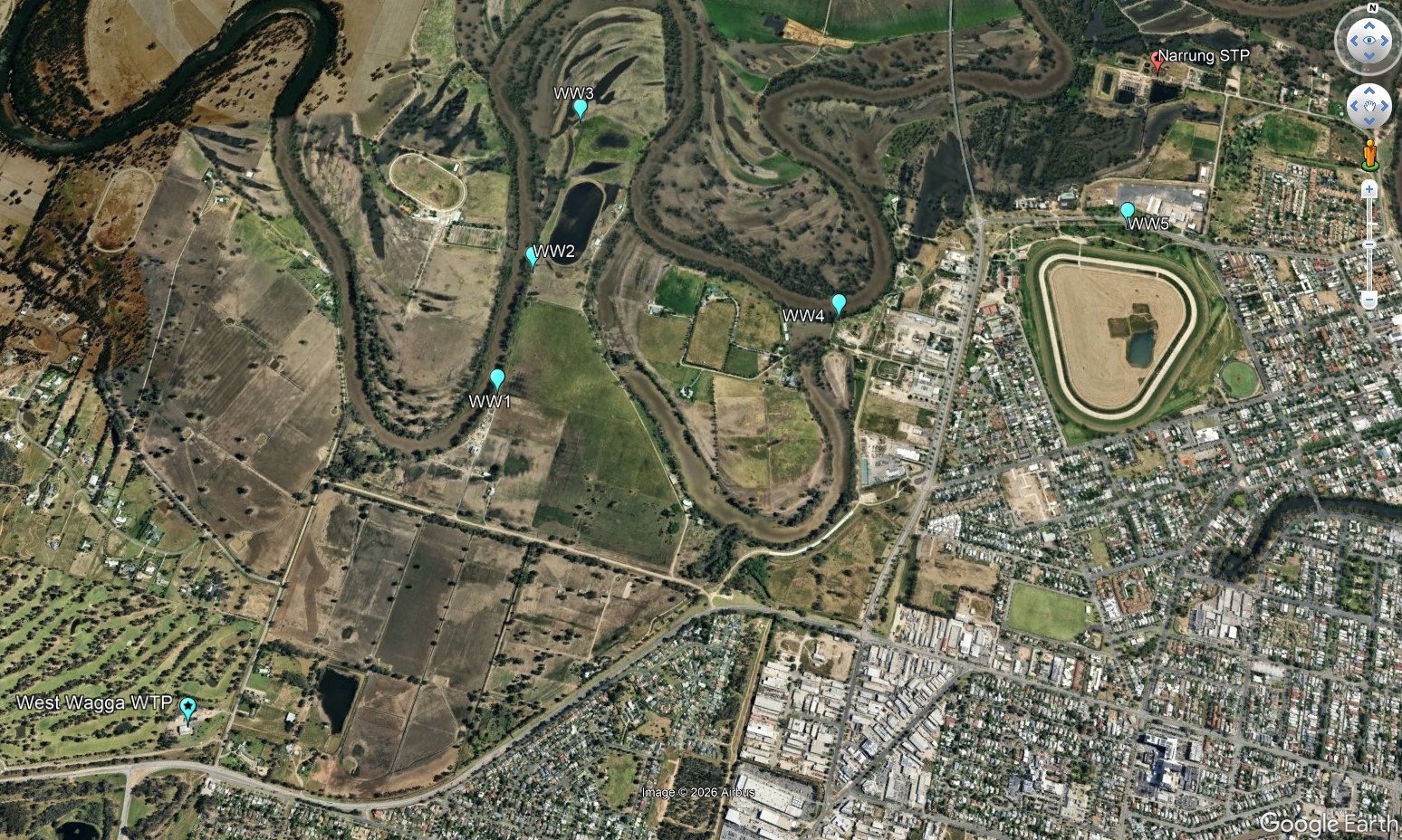
The Western Wagga water supply system highlighting the location of the West Wagga WTP and five drinking water bores, WW1, WW2, WW3, WW4 and WW5. The location of the Narrung STP is marked with a red pin. PFAS has been impacting WW4 since late 2024, but was detected as early as 2019 in a screening program by Riverina Water. Data for WW4 on the Riverina Water website is only available from September 2023 onwards.
Average PFAS detections at WW4 (November 2024/April 2026) have been PFOS 0.0067µg/L and PFHxS 0.0113µg/L. That's 83.7% and 37.6% of the Australian Drinking Water Guidelines respectively. Average PFAS detections at WW5 (April 2025/July 2026) have been PFOS 0.0071µg/L and PFHxS 0.008µg/L. That's 88.7% and 26.7% of the Australian drinking water guidelines respectively. Only two tests have been conducted at WW1 and WW2. PFAS was detected in September 2025, but not March 2026.
Average levels of PFAS at West Wagga Water Treatment Plant since testing began in July 2025 have been PFOS 0.00258µg/L and PFHxS 0.00417µg/L. That's 32.2% and 13.9% of the Australian Drinking Water Guidelines respectively. Water from the West Wagga WTP provides 29ML/day of drinking water with water primarily supplying the Southern Trunk region.
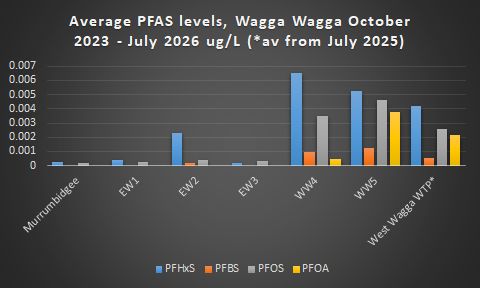
Comparison of PFAS chemicals detected in Wagga Wagga bores October 2023-July 2006. Much higher levels have been detected in West Wagga bores, than East Wagga bores and the Murrumbidgee River. Most concerning are the PFAS levels detected at the West Wagga Water Treatment Plant which were averaging about 46% (to March 2026), reducing to 32% (to July 2026) of the drinking water guideline for PFOS. A PFOS detection of 0.0065µg/L (81% of the guideline level) was detected in February 2026.

PFAS detections West Wagga Bore 5 could have peaked in late 2025.

PFAS levels at West Wagga WTP show two peaks in November 2025 and February 2026.

West Wagga WTP PFAS detections highlighting comparison to guidelines for each of the PFAS chemicals under the Australian Drinking Water Guidelines. PFOS is the most significant problem due to its lower guideline level. However PFOS detections decreased to <0.002ugL between April - June 2026.
In February 2022, Friends of the Earth highlighted the fact that groundwater contamination has been occurring in Victoria from sewage treatment plants. From Freedom of Information documents gained by FoE it was determined that 62.5% of testing regimes found were positive for PFAS at Western Water facilities, with 32.3% positive at South East Water plants. In terms of individual chemical samples, Western Water recorded 101 positives (~7.5% of all samples) and South East Water 230 positives (~4.3% of all samples). If groundwater pollution had been occurring from sewage treatment plants in Victoria could the same issue be occurring at Wagga?
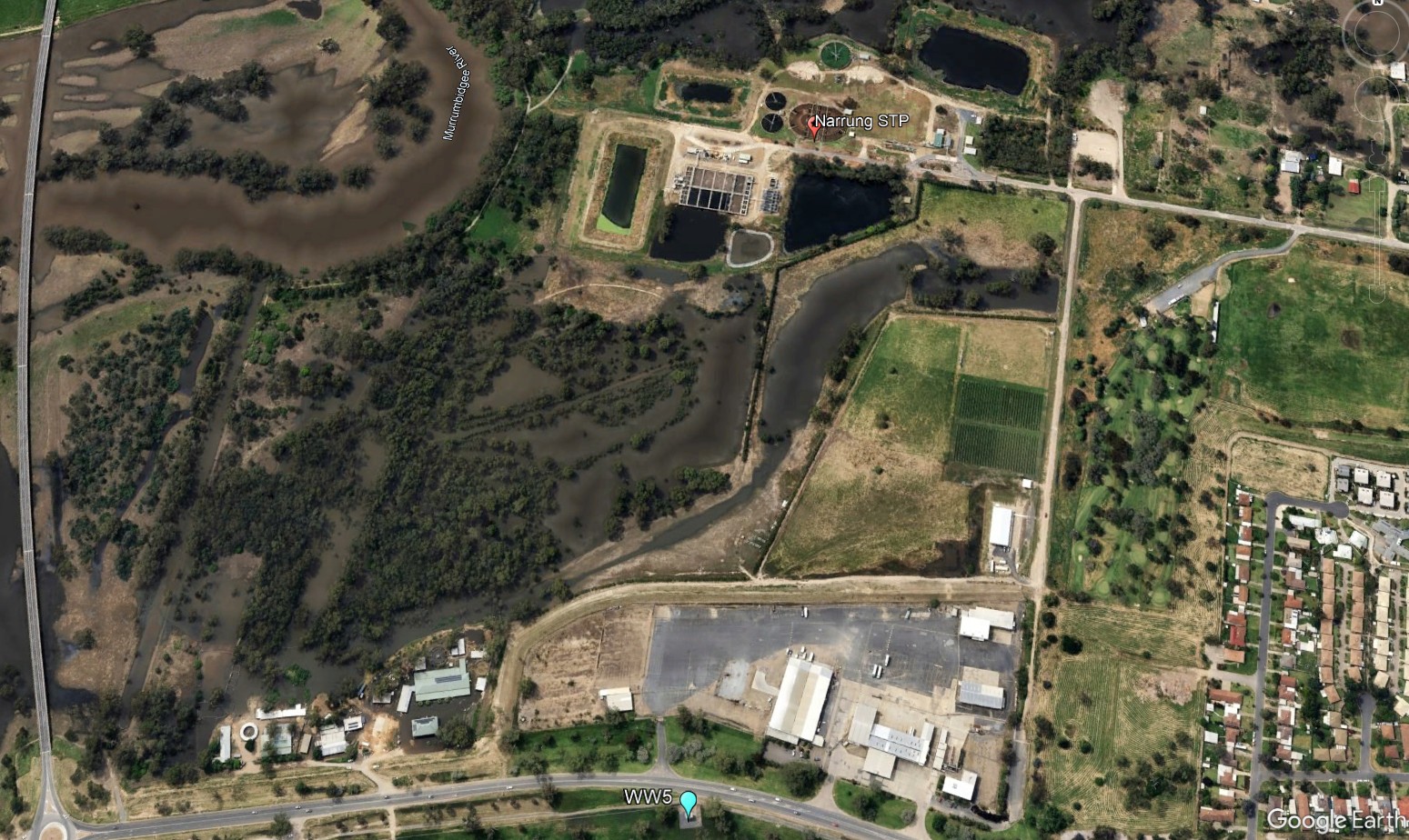
The Narrung Street, Sewage Treatment Plant is located only 600 metres north of Bore WW5, which incidently has had the highest PFAS detections in the Wagga Wagga drinking water supply. The groundwater contamination could also be coming from other sources. A detailed investigation is required to determine the source of the contamination, the depth of the groundwater plume and the speed at which the plume is moving. It may be that bores WW5 and WW4, may have to be shut down. This has occurred in other locations where PFAS has polluted groundwater.
PFAS pollution is often associated with airports, fire stations, landfills and industry. The nearest fire station is 1.4km south east of WW5. Recycled water from Narrung Street STP is also likely to be contaminated with PFAS. According to the council: "Narrung Street STP effluent is used on a number of sites, including; on-site, Bolton Park, Wagga Wagga Cricket Ground and McPherson Oval. Kooringal STP reuse sites include Rawlings Park and an onsite treelot".

PFAS testing at Narrung Street Sewage Treatment Plant started in 2019, so Council has been aware of the issue for 7 years. What council probably was not aware of in 2019 was the potential for PFAS from the STP to pollute the city's drinking water supply. The highest amounts detected in leachable tests have been for PFBA. Riverina Water tests for drinking water do not publicly show levels of PFBA in drinking water.
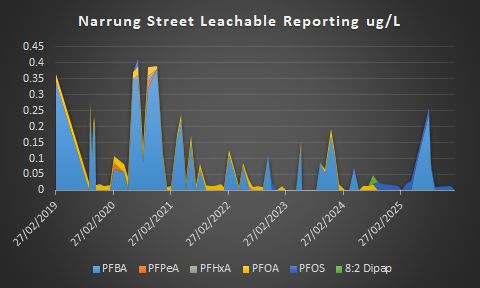
PFBA has dominated PFAS detections from leachable tests at Narrung Street Sewage Treatment Plant since 2019. Amounts seem to have decreased from peaks in 2020. PFOS detections have occurred in Narrung Street Leachables since September 2024.

Biosolids testing at Narrung Street Sewage Treatment Plant have been dominated by PFOS, particularly since 2020. Biosolid piles, can leach PFAS chemicals into soil and groundwater. A Contract for removal and processing of biosolids by the Trustee for the Bannatyne Family Trust was approved by Council in October 2023 for the removal and processing of biosolids from Narrung Street Treatment Works and Kooringal Treatment Works as per EPA guidelines. CONF-1 RFT2023-25 REMOVAL AND PROCESSING OF BIOSOLIDS. It is unclear where the biosolids have been transported to.

Total amounts of PFAS in biosolids from Narrung Street STP. "PFDA is well resistant to heat, oil, stains, grease and water, therefore it has been used in stain and greaseproof coating for furniture, packaging and carpet. Next to that, PFDA has also been found in nano-and impregnation-sprays, outdoor textiles, gloves, ski wax, leather, cosmetics, medical equipment and paper-based food containers."

Forest Hill Sewage Treatment Plant located 10km east of the Wagga Wagga CBD, has been receiving PFAS at much higher volumes than Narrung Street and Kooringal STP's. Forest Hill STP is however not located near drinking water bores but is located within 400 metres of Kyeamba Creek, which in turn flows into the Murrumbidgee River ~2km north of the STP. The Murrumbidgee River provides 1/3 of Wagga Wagga's drinking water.
The Forest Hill STP site is located 10.3km south east of Wagga Wagga and ~3km north of the Wagga RAAF Base. The site will be contaminated with PFAS for decades to come as PFAS has been transferred from the contaminated military base to a sewage treatment plant managed by local government.
The site receives two waste streams, one from the suburb of Forest Hill and the other from the RAAF base. The RAAF effluent is treated and then sent to settlement ponds for use on surrounding agricultural land. It is highly likely that this farmland will be contaminated with PFAS as treatment will not remove all of the PFAS.
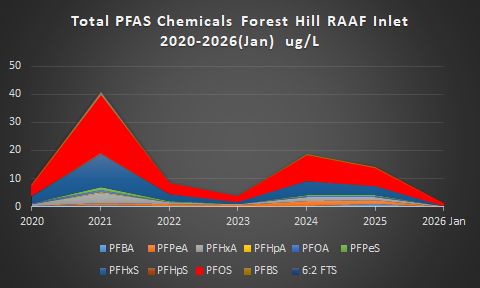
Forest Hill Sewage Treatment plant has received vastly more amounts of PFAS chemicals since 2020 than Narrung Street. PFOS is the PFAS chemical that has been detected in the highest quantities
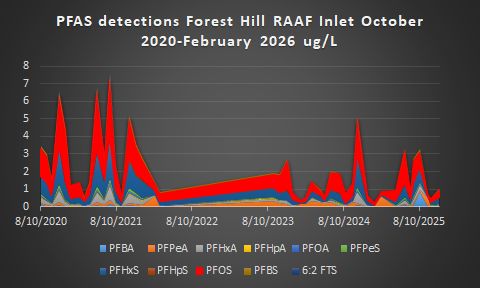
PFOS has dominated PFAS detections at Forest Hill, due mainly to the contamination of the Wagga RAAF Base. There appears to be no monitoring for PFAS chemicals in groundwater, stream flow or farmland surrounding the Forest Hill STP.
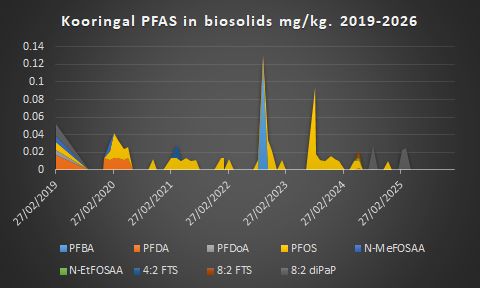
Kooringal STP has also had a number of PFAS detections but in amounts less than Narrung Street. Kooringal mostly treats domestic sewage from Kooringal, Tatton, Lake Albert, and the pressure sewer from East Wagga and Gumly Gumly.
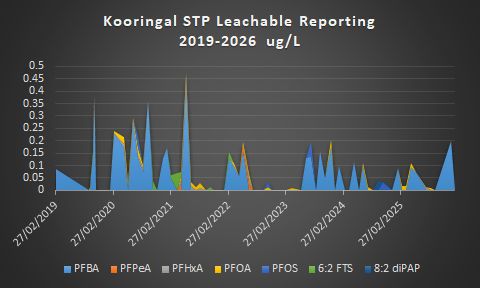
Kooringal STP leachable reporting has like, Narrung Street, been dominated by PFBA.
Donations are always appreciated and help us with our PFAS research
For more information contact: [email protected]